Europe eSIM vs Wi-Fi: What Should US Travellers Use?
If you’re planning a trip to Europe, the big question is often simple: should you rely on Wi-Fi, or get a Europe eSIM vs Wi-Fi setup that keeps you connected wherever you go? For most US travellers, the answer depends on how much you move around, how much data you use, and whether you want internet access the moment you land.
Quick answer: Wi-Fi can work fine if you’re staying in one place and only need light internet use. But for most travellers, a Europe eSIM is the more flexible choice because it gives you mobile data on the go for maps, rides, banking alerts, messaging and train travel without hunting for the next hotspot.
Roamzy’s Europe eSIM is a practical option if you want reliable data across cities and borders, especially on multi-country trips. It’s also useful for travellers who don’t want to depend on hotel login pages, café passwords, or patchy airport Wi-Fi the whole trip. If you want a simple way to stay connected outside your accommodation, start by checking the Roamzy Europe eSIM option below.

Europe eSIM vs Wi-Fi: Which Is Better for US Travellers?
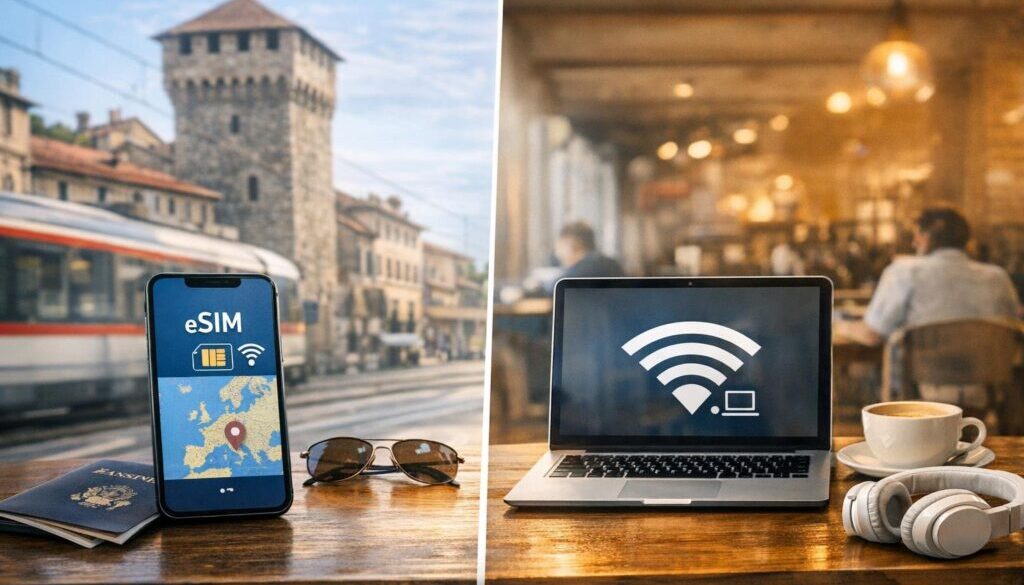
Think of Wi-Fi as a place-based connection and a Europe eSIM as a travel-wide connection. Wi-Fi only works when you’re near a network. A Europe eSIM gives your phone mobile data across supported destinations, so you can check maps, book transport, translate signs, or message family while you’re out exploring.
For light users who spend most of the day in hotels, rentals, or cafés, Wi-Fi may be enough. For travellers who leave the hotel early, move around often, or cross borders, a Europe eSIM usually wins on convenience and reliability.
| Feature | Europe eSIM | Wi-Fi |
|---|---|---|
| Works on the move | Yes | No |
| Setup before departure | Usually yes | No |
| Best for navigation and rides | Yes | Only when connected |
| Best for hotel use | Yes | Yes |
| Best for multi-country travel | Usually yes | No |
| Security on public networks | Typically better than public Wi-Fi | Varies |
What Is a Europe eSIM?
A Europe eSIM is a digital SIM that lets your compatible phone connect to mobile data in Europe without swapping a physical SIM card. You usually install it before your trip, then activate it when you land or when your plan starts.
How eSIMs work
Instead of inserting a plastic SIM, you download a travel plan to your phone. That makes it much easier to get online quickly after a long flight. You can often keep your US number active for calls or texts while using the eSIM for data.
Why travellers use them in Europe
- Google Maps works anywhere, not just where Wi-Fi is available
- You can book trains, rides, and tickets on the move
- It’s easier to stay connected across multiple countries
- You don’t need to ask for Wi-Fi passwords everywhere you go
What Is Wi-Fi When Travelling in Europe?
When travellers say “I’ll just use Wi-Fi,” they usually mean a mix of hotel Wi-Fi, airport Wi-Fi, public hotspots, and café connections. That can be fine, but each option comes with trade-offs.
Hotel Wi-Fi
Hotel Wi-Fi is often the easiest option when you’re back at your room, but it may be slow, crowded, or limited to certain parts of the property. Some hotels also have separate login steps for every device.
Airport and public Wi-Fi
Airport Wi-Fi can help at arrival, but it may not be ideal for everything. Public networks can be useful in a pinch, but they are not the same as having your own mobile data connection.
Café and restaurant Wi-Fi
This is great for sitting down and catching up on messages, but it’s not a dependable plan for a full travel day. If you want to walk, explore, move between attractions or catch a last-minute train, Wi-Fi won’t always follow you.
Europe eSIM vs Wi-Fi: Key Differences
Convenience
A Europe eSIM is more convenient for active travel because it works beyond your accommodation. Wi-Fi is only convenient when you happen to be in the right place at the right time.
Coverage and availability
Wi-Fi availability varies by hotel, neighbourhood, city and country. A Europe eSIM is generally more consistent because your phone can connect to mobile networks as long as your plan covers the destination.
Speed and reliability
Hotel Wi-Fi can be fast, but it can also slow down when many guests are using it. Public Wi-Fi is less predictable. Mobile data from a Europe eSIM is often more reliable for everyday travel tasks, especially for maps and ride-hailing.
Security and privacy
Public Wi-Fi is not ideal for sensitive tasks like banking or checking important accounts. A mobile data connection is usually the safer everyday choice when you’re away from trusted networks. If you expect to use lots of public networks, consider pairing your trip with Roamzy Secure™ Travel VPN for an extra layer of privacy.
Cost
Wi-Fi may appear free, but “free” often means trading away convenience. You may spend time looking for access, dealing with slow connections, or using paid add-ons at hotels. A Europe eSIM gives you a more predictable trip setup because the data plan is arranged before you go.
Setup and activation
Wi-Fi requires no setup at all, which is its main advantage. A Europe eSIM does need installation, but once it’s ready, you have immediate access when you need it. For many US travellers, that extra setup time pays off after landing.
Ready to Stay Connected?
Compare Roamzy’s Europe eSIM options and choose a plan that suits your trip.
When Wi-Fi Might Be Enough
Wi-Fi can be enough if your trip is simple and your data needs are light.
Short trips
If you’re only away for a few days and mostly staying in one city, Wi-Fi may cover a lot of your needs.
Light data users
If you mainly check email, message occasionally, and browse in the evening, you may not need mobile data all day.
Travellers staying mostly in hotels or rentals
If your accommodation has dependable Wi-Fi and you rarely leave for long, relying on Wi-Fi may be practical enough.
When a Europe eSIM Is the Better Choice
Multi-city or multi-country trips
If you’re visiting Paris, Rome, Barcelona and Amsterdam on one trip, Wi-Fi becomes a lot less useful because you’re constantly changing places. A Europe eSIM is built for that kind of travel.
Navigation, ride apps and train travel
Many travellers discover quickly that the real need isn’t just “internet” — it’s live internet. Maps, ride apps, railway apps and translation tools are much better when you’re connected outside the hotel.
Remote work or frequent checking in
If you need to join calls, send documents, verify logins or handle work messages while out for the day, depending on Wi-Fi alone gets frustrating fast.
Families and groups
Families often split up for a few hours, and having your own data helps everyone stay in touch. It also makes it easier to coordinate meet-ups, tickets and timing.
Should You Use Both eSIM and Wi-Fi?
Yes — for many travellers, the best answer is both. That’s because they solve different problems.
- Use Wi-Fi for large downloads, streaming at your hotel, or late-night backups
- Use a Europe eSIM for maps, messaging, transport, banking alerts and staying online while out
This hybrid approach is especially useful if you want to control costs without giving up convenience. You’re not forced to burn mobile data for everything, but you’re also not stuck without internet when you leave your room.
How to Choose the Right Option for Your Trip
Budget
If your main goal is to spend as little as possible and you’re happy to work around access points, Wi-Fi can be a budget choice. If your time matters more than chasing hotspots, a Europe eSIM often delivers better value.
Device compatibility
Not every phone supports eSIM, and your phone needs to be unlocked. Check compatibility before you buy so you don’t run into surprises after landing.
Trip length
The longer the trip, the more useful a Europe eSIM usually becomes. A weekend in one city is different from two weeks across several countries.
Data needs
If you use Google Maps, ride apps, WhatsApp, banking apps and translation tools during the day, Wi-Fi alone may feel limiting. A data plan gives you room to move.
Countries visited
If your itinerary crosses borders, choose a Europe eSIM that matches the countries you’re visiting. That is much easier than trying to depend on individual Wi-Fi networks in every place you stop.
For a broader comparison of mobile data options, you may also want to read about travel eSIM vs roaming and how much data you need for travel.
Practical Travel Examples
Airport arrival: You land in Europe, switch on your eSIM, open your map and book your transfer without looking for a café or terminal hotspot.
City day trip: You’re moving between museums, tram stops and restaurants. Wi-Fi is not a realistic option, but mobile data keeps everything easy.
Hotel evening: You can still use the hotel Wi-Fi for streaming, uploads or downloading tomorrow’s tickets while keeping your eSIM for the next day.
Bank verification: If your bank sends a one-time code, having your own connection can save you from fumbling with unreliable public networks.
Recommended Option for Most US Travellers
For most US travellers, the better choice is a Europe eSIM vs Wi-Fi decision that leans toward the eSIM. Wi-Fi still matters, especially at your accommodation, but a Europe eSIM gives you the freedom to use your phone like normal while you’re actually travelling.
If your trip involves more than one city, more than one country, or any real amount of time away from your hotel, a Europe eSIM is usually the more useful and less stressful option. Wi-Fi is best treated as a bonus, not your only plan.
Ready to Stay Connected?
Compare Roamzy’s Europe eSIM options and choose a plan that suits your trip.
Roamzy Travel Tip™
Roamzy Travel Tip™: Install your Europe eSIM before you leave the US, then test your phone settings at home while you still have access to your regular connection. That way, you know exactly how to switch data on when you land and you won’t be troubleshooting in an airport queue.
Related Travel
If you’re the kind of traveller who likes to learn as you go, you may also enjoy Walkables – Immersive Self Guide Audio Walking Tours From Around Europe when exploring European cities on foot.
FAQs: Europe eSIM vs Wi-Fi
Is Wi-Fi enough for travelling in Europe?
It can be enough for short, low-data trips, but it’s rarely the best option if you want reliable access while out and about.
Is a Europe eSIM worth it for US travellers?
Yes, especially if you want mobile data for maps, transport, messaging and multi-country travel without relying on hotspots.
Which is cheaper: Europe eSIM or Wi-Fi?
Wi-Fi may look cheaper because many networks are included with accommodation, but a Europe eSIM can be better value when you factor in convenience and time saved.
Can I use both a Europe eSIM and Wi-Fi?
Yes. Many travellers use Wi-Fi in their hotel and mobile data everywhere else.
Do I need an unlocked phone for a Europe eSIM?
Usually yes. Your phone also needs to support eSIM.
Does a Europe eSIM work in multiple countries?
Many Europe eSIMs are designed for multi-country use, but you should always check the plan coverage before you buy.
Is public Wi-Fi safe for banking?
Public Wi-Fi is not ideal for sensitive tasks. A mobile data connection is generally a safer choice for banking and important logins.
Should I buy an eSIM if my hotel has free Wi-Fi?
If you plan to spend time away from the hotel, yes. Free Wi-Fi in one place does not replace mobile data when you’re travelling around.
Final Verdict
If you’re comparing Europe eSIM vs Wi-Fi, the simplest answer is this: Wi-Fi is useful, but a Europe eSIM is usually the better travel tool. It gives US travellers the flexibility to stay connected when it matters most — on arrival, in transit, in city centres, and across borders.
For a trip that feels easier from day one, consider Roamzy’s Europe eSIM before you leave. Then use Wi-Fi as a bonus when it’s available, not as the only plan.