eSIM for Europe: How Much Data Do You Really Need?
If you’re planning a trip and wondering how much data your eSIM for Europe should include, the answer depends on how you travel. A weekend city break, a two-week holiday, and a remote working trip can use very different amounts of data.
The good news is you do not need to guess. Once you understand how much data maps, messaging, social media, streaming, and video calls use, it becomes much easier to choose the right Europe eSIM plan without overpaying or running out halfway through your trip.
Quick answer: light travellers can often manage on a small data allowance, most holidaymakers are better off choosing a moderate plan, and digital nomads or heavy users should look at larger data options or unlimited data. If you want an easy way to compare Europe options before you fly, Roamzy’s Europe eSIM range is a practical place to start.

That said, the best plan depends on your actual usage. In this guide, we’ll break down real-world travel habits so you can estimate how much data your eSIM for Europe really needs.
How much data do you really need for Europe?
The right allowance depends on three main things:
- What you do online each day — maps, social apps, emails, streaming, calls, hotspot use.
- How long you travel for — a 5-day trip is very different from a month abroad.
- How many countries you visit — multi-country trips usually mean more navigation, more planning, and more mobile usage.
For many travellers, the biggest surprise is not video streaming. It is everyday phone use: Google Maps, ride apps, WhatsApp, translation apps, hotel check-ins, and photo uploads all add up faster than expected.
If you’re comparing options for a Europe trip, a dedicated eSIM for Europe is usually easier to manage than juggling roaming add-ons or buying local SIM cards in every country.
What affects your data usage while travelling?
1. Maps and navigation
Navigation is one of the most common travel data uses. Google Maps, Apple Maps, and ride-hailing apps can use a modest amount individually, but they’re often opened many times a day. If you’re walking around cities, changing trains, or driving between regions, your usage adds up.
2. Messaging and email
Text-based messaging apps use very little data, even with regular use. Email is also usually light unless you’re downloading large attachments or sending lots of files.
3. Social media browsing and uploads
Scrolling social apps is usually manageable, but uploading photos and especially short videos can use much more data than people expect. If you post often while travelling, your allowance needs to be larger.
4. Music and video streaming
Streaming is where data use can rise quickly. Music is moderate, but video is heavy. A few hours of video each day can consume far more data than casual browsing.
5. Video calls and remote work
If you plan to work from Europe, join video meetings, or use your phone as a hotspot, you’ll need a much bigger allowance. Video calls and tethering are among the fastest ways to burn through data.
Typical data use for common travel activities
The exact amount varies by app, quality settings, and device, but the table below gives a practical travel estimate for planning purposes.
| Activity | Typical data impact | Traveller note |
|---|---|---|
| Maps and navigation | Low to moderate | Usually fine for daily use, but frequent route changes add up |
| Messaging apps | Very low | Great for WhatsApp, iMessage, Messenger, and similar apps |
| Low | Mostly light unless attachments are large | |
| Social media browsing | Moderate | Video-heavy feeds use more than simple photo browsing |
| Photo uploads | Moderate | Frequent uploads increase usage quickly |
| Music streaming | Moderate | Manageable if quality settings are reduced |
| Video streaming | High | Can consume a lot of data in a short time |
| Video calls | High | Best planned for larger plans or unlimited data |
| Hotspot / tethering | High | Useful, but easy to underestimate |
Data estimates by traveller type
Light user
Light users mostly rely on Wi-Fi and only use mobile data for messaging, navigation, checking emails, and occasional browsing. If that sounds like you, a smaller Europe eSIM plan may be enough for a short trip.
Good fit for:
- Weekend city breaks
- Retirees who mainly want maps and communication
- Travellers who use hotel and café Wi-Fi most of the time
Moderate user
Moderate users are the most common type of traveller. They use maps daily, stay active on social apps, send photos, check email, and browse the web throughout the day. For this group, a mid-sized eSIM for Europe is often the safest choice.
Good fit for:
- One- to two-week holidays
- Families sharing travel planning tasks
- Travellers visiting several European cities
Heavy user
Heavy users stream video, upload a lot of content, use hotspot regularly, or spend much of the day online. If that is your style, a larger plan or unlimited data is usually more sensible than trying to make a small allowance stretch.
Good fit for:
- Long stays
- Digital nomads
- Frequent video callers
- Travellers working remotely from hotels, cafés, or trains
Remote worker or digital nomad
If you need reliable daily connectivity for work, your question is less about “how little can I buy?” and more about “how much margin do I need?” Video meetings, file uploads, cloud tools, and hotspot use can make an allowance disappear quickly. In this case, an unlimited or high-data plan can be the easier option.
How to estimate the right eSIM plan
A simple way to choose your eSIM for Europe is to think about your daily habits, then multiply them by the length of your trip.
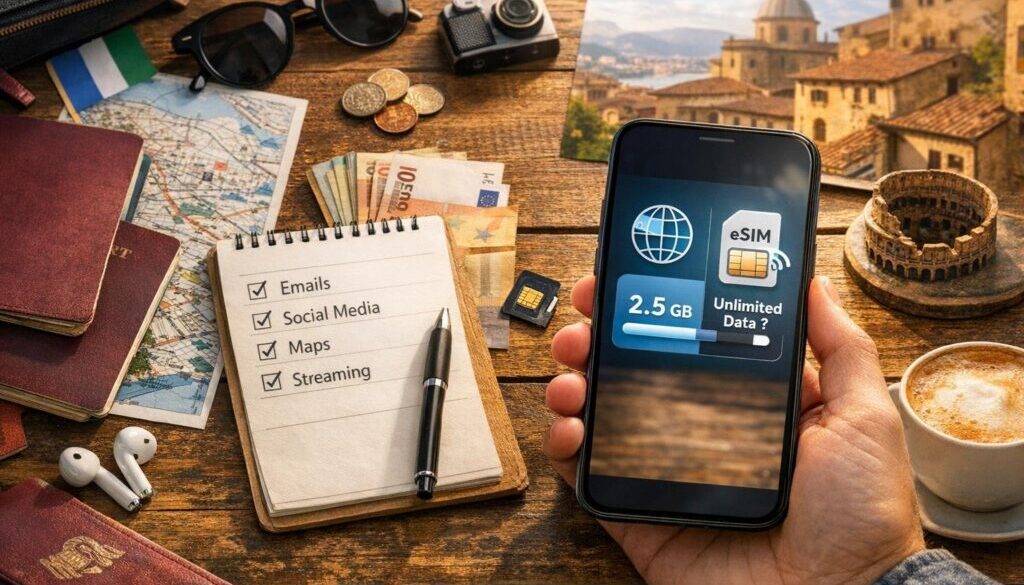
Step 1: Make a daily data checklist
- Will you use maps every day?
- Will you upload photos and videos?
- Will you stream music or video?
- Will you take video calls?
- Will you use hotspot for another device?
Step 2: Add a buffer
Always leave a little extra room. Travel data use is rarely neat and predictable. One rainy afternoon in a hotel, one long train ride, or a few extra video calls can change your usage pattern fast.
Step 3: Match plan size to trip length
A short trip does not always need a huge allowance, but a long trip can make even moderate daily use add up. If you are visiting multiple countries, choose a plan that covers the full itinerary instead of trying to piece together separate solutions.
Ready to Stay Connected?
Compare Roamzy’s Europe eSIM options and choose a plan that suits your trip.
Common mistakes when choosing an eSIM for Europe
Underestimating navigation and social app usage
Many travellers assume messaging is the main data user, but maps, photo uploads, and social feeds are often the bigger drivers.
Forgetting hotspot or video call needs
If you plan to share your connection with a laptop or tablet, your data needs can increase very quickly. The same applies to regular video meetings.
Buying a plan that does not cover enough countries
Europe trips often cross borders. If your itinerary includes more than one country, a Europe-wide eSIM for Europe can be much simpler than managing separate plans for each destination.
Choosing based only on price
The cheapest plan is not always the best value. If it runs out early, you may end up paying more to top up or switching to roaming at the last minute.
Why an eSIM can be better than roaming
For many travellers, an eSIM is easier and more predictable than traditional roaming.
| Feature | eSIM for Europe | Traditional roaming |
|---|---|---|
| Setup | Usually installed before departure | May depend on carrier settings or add-ons |
| Cost control | Clear plan size and allowance | Can be harder to predict |
| Multi-country use | Often built for regional travel | May require different roaming rules by country |
| Convenience | Easy to activate on arrival | Can involve checking carrier terms and roaming settings |
If you want to avoid bill shock and keep control over usage, a travel eSIM is often the cleaner option. Just make sure your phone is eSIM-compatible before you buy.
Choosing the right Roamzy Europe eSIM
Roamzy’s Europe eSIM options are designed for travellers who want a simple way to stay connected across the trip. The right choice depends on how much data you use and whether you’re travelling for leisure, work, or a mix of both.
In general:
- Smaller plans suit light users and short trips.
- Mid-sized plans suit most holidaymakers and city hoppers.
- Larger or unlimited plans suit heavy users and remote workers.
Before you buy, check:
- Which countries are included
- Whether hotspot use is allowed
- How long the plan lasts
- Whether the allowance matches your trip style
- That your phone supports eSIM
Ready to Stay Connected?
Compare Roamzy’s Europe eSIM options and choose a plan that suits your trip.
Roamzy Travel Tip™
💡 Roamzy Travel Tip™ Download offline maps before you leave your accommodation each day. It reduces pressure on your data allowance and keeps navigation working even in spotty signal areas like rail stations, older city centres, and rural roads.
FAQs about eSIM for Europe data
Is 1GB enough for Europe?
It can be enough for very light use on a short trip, especially if you mainly need maps, messaging, and occasional browsing. If you plan to post often or use navigation heavily, 1GB may feel tight.
Is 5GB enough for a week in Europe?
For many travellers, 5GB is enough for a short holiday if you stay sensible with video streaming and hotspot use. It is a common choice for moderate users on city breaks.
Is 10GB enough for two weeks?
Often yes for a typical holidaymaker, but not if you stream a lot, upload many videos, or use your phone as a hotspot. The more you rely on mobile data instead of Wi-Fi, the more allowance you will need.
Do I need unlimited data?
You probably do if you work remotely, use video calls often, stream frequently, or want complete peace of mind. Casual travellers usually do not need unlimited data.
Can I use one eSIM across multiple European countries?
Many Europe eSIM plans are built for multi-country travel, which is one of their biggest advantages. Always check the country list before buying so it matches your itinerary.
What happens if I run out of data mid-trip?
You may need to top up, switch to Wi-Fi, or buy another plan. That is why it is smart to add a buffer when choosing your allowance in the first place.
Can I use hotspot with a Europe eSIM?
Some plans allow hotspot use and some do not, so check the plan details before buying if you plan to share data with a laptop or another device.
How do I avoid overpaying for data?
Estimate your real daily use, then choose the smallest plan that still gives you a comfortable buffer. If you are unsure, it is usually better to slightly overestimate than run short.
Final verdict: how much data should you choose?
If you only use your phone for maps, messages, and a bit of browsing, a smaller eSIM for Europe may be enough. If you use social media, upload photos, and rely on your phone throughout the day, a mid-sized plan is usually safer. If you work remotely, stream often, or hotspot other devices, consider a larger or unlimited option.
The best approach is to match your allowance to your travel style rather than guessing based on trip length alone. That way you stay connected, avoid surprise charges, and buy a plan that actually fits the way you travel.
If you are ready to compare options, choose a Europe eSIM before you fly and set yourself up for a smoother trip.
Related reading
- Europe eSIM plans
- How to activate an eSIM before travel
- How to check if your phone supports eSIM
- eSIM-compatible phones
- Roaming vs eSIM
- Best eSIM for multi-country Europe travel
- How to use hotspot with an eSIM
- Coverage in Europe by country
- Travel data usage tips