“`html

“`
“`html
“` “`html
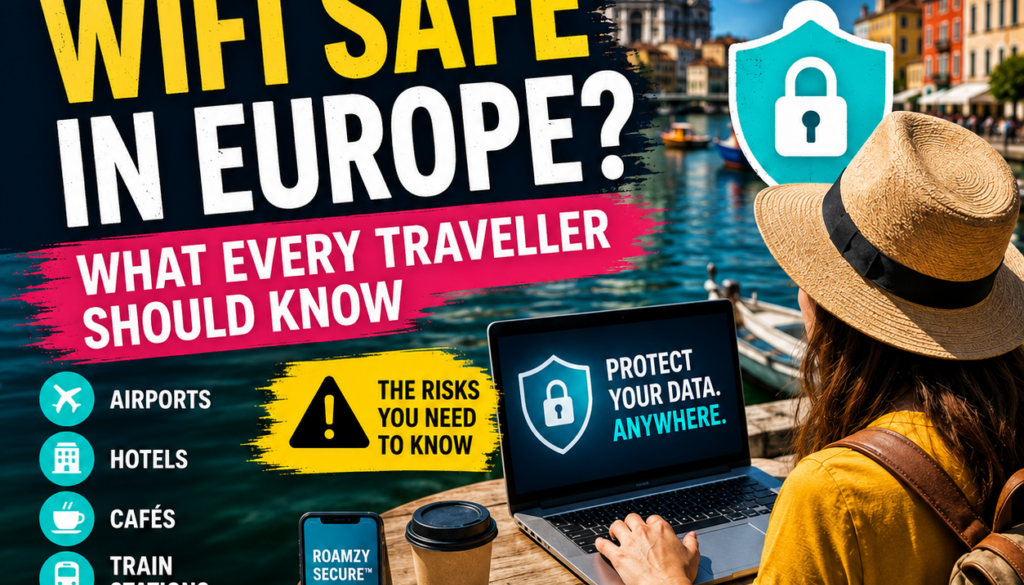
Is Free WiFi Safe in Europe? What Every Traveller Should Know
Free WiFi is everywhere in Europe, but is it safe to use? Here’s what we’ve learned after years of travelling across Europe by train, bicycle and river cruise.
Is Free WiFi Safe in Europe? It’s a question many travellers ask before heading overseas. While free WiFi can be incredibly convenient, it also comes with risks that many people don’t think about until it’s too late. After travelling extensively across Europe by train, bicycle, river cruise and independent holidays, we’ve learned that free WiFi is a useful travel tool—but it shouldn’t be trusted blindly.
Whenever we know we’ll be using airport, hotel or café WiFi, we also use Roamzy Secure™ Travel VPN to help protect our online activity. Combined with a Roamzy Europe eSIM, it gives us the flexibility to stay connected without relying solely on public networks.
The good news is that you don’t need to avoid free WiFi altogether.
You simply need to understand where it’s useful, when to be cautious and how to protect yourself while travelling.
Quick Answer
Is Free WiFi Safe in Europe? Most public WiFi networks are legitimate, but they are not always secure. Airports, hotels, cafés and train stations often provide free internet access, however travellers should avoid assuming every network is safe. Using a trusted VPN, enabling two-factor authentication and having your own mobile data available are simple ways to reduce risk.
Table of Contents
Is Free WiFi Safe in Europe? Understanding the Risks
Most travellers think of free WiFi as a convenience.
We certainly did when we first began travelling throughout Europe.
Hotels proudly advertised complimentary internet.
Airports promoted free WiFi.
Restaurants and cafés displayed WiFi passwords on menus.
It all seemed perfectly normal.
The reality is that public WiFi networks vary enormously in how they’re managed and secured.
Some are professionally maintained.
Others are open networks that anyone can join.
While that doesn’t automatically make them dangerous, it does mean travellers should be careful about what they do while connected.
Activities that deserve extra caution include:
- Online banking
- Shopping with credit cards
- Accessing work emails
- Viewing confidential documents
- Logging into financial accounts
Is Airport WiFi Safe in Europe?
European airports generally provide reliable WiFi for travellers.
We’ve used airport WiFi in cities including Amsterdam, Paris, Frankfurt, Vienna and Budapest.
Most of the time it works well for checking emails, downloading boarding passes and confirming transport connections.
However, airports are also busy public spaces where thousands of people connect every day.
That’s why we avoid accessing sensitive accounts unless absolutely necessary.
Instead, we use airport WiFi for low-risk activities such as:
- Checking flight information
- Using Google Maps
- Reading travel emails
- Downloading train tickets
- Finding transport options
When we need to access more sensitive information, we switch on Roamzy Secure™ or use our Roamzy Europe eSIM instead.
Is Hotel WiFi Safe in Europe?
Hotel WiFi is one of the most commonly used internet services for travellers.
In our experience, most hotels provide perfectly adequate internet for everyday browsing.
However, the level of security varies considerably between properties.
We’ve stayed in hotels where:
- Every room had its own secure login.
- A single password was shared with every guest.
- No password was required at all.
Those differences don’t necessarily mean a network is unsafe, but they do remind us that we don’t know how every hotel manages its WiFi.
For that reason, we treat hotel WiFi as convenient rather than automatically secure.
Stay Connected Securely Across Europe
Use free WiFi when it’s convenient, but travel with the confidence of a Roamzy Europe eSIM and the added protection of Roamzy Secure™ whenever you’re using public networks.
Learn More About Roamzy Secure™Is Café WiFi Safe in Europe?
Cafés are one of our favourite places to stop while travelling across Europe.
Whether it’s enjoying a coffee in Paris, planning the day’s route in Germany or taking a break during a cycling tour in the Netherlands, café WiFi can be extremely convenient.
However, convenience shouldn’t be confused with security.
Many cafés use open or shared WiFi networks that allow dozens of customers to connect throughout the day.
That doesn’t automatically make them unsafe, but it does mean you should think carefully about what you’re doing while connected.
We happily use café WiFi for activities such as:
- Reading emails
- Researching attractions
- Planning the next day’s journey
- Uploading travel photos
- Checking restaurant reviews
When it comes to banking, accessing personal documents or making important purchases, we either use our Roamzy Europe eSIM or enable Roamzy Secure™ before continuing.
How We Protect Ourselves When Using Free WiFi in Europe
After years of travelling throughout Europe, we’ve developed a simple routine whenever we connect to public WiFi.
These habits don’t take long, but they help reduce unnecessary risks.
1. Check the Network Name
Before connecting, we always confirm the correct WiFi network with hotel reception, airport information desks or café staff.
Fake hotspots can use names that closely resemble legitimate networks.
2. Use Roamzy Secure™ on Public Networks
Whenever we’re using airport, hotel, café or campground WiFi, we activate Roamzy Secure™ Travel VPN.
This helps protect our internet connection while using public networks and gives us additional peace of mind.
3. Keep Sensitive Tasks for Mobile Data
If we’re logging into banking apps, accessing important documents or making significant online purchases, we generally prefer using our Roamzy Europe eSIM instead of public WiFi.
4. Enable Two-Factor Authentication
Where available, we recommend enabling two-factor authentication for important accounts such as email, banking and online shopping.
It’s a simple step that provides valuable additional protection.
When We Choose Mobile Data Instead of Free WiFi
Although we still use free WiFi regularly, there are situations where we automatically switch to mobile data.
Examples include:
- Navigating unfamiliar cities using Google Maps
- Booking last-minute accommodation
- Buying train tickets through Trainline
- Checking travel insurance information
- Using banking apps
- Communicating with family during travel delays
Reliable mobile connectivity means we don’t need to search for the nearest WiFi hotspot whenever plans unexpectedly change.
Free WiFi vs Mobile Data: Which Is Better?
| Feature | Free WiFi | Roamzy Europe eSIM |
|---|---|---|
| Available While Travelling | Sometimes | Yes |
| Works Between Destinations | Usually No | Yes |
| Navigation | Limited | Excellent |
| Train Travel | Limited | Excellent |
| Hotel Check-in | After Arrival | Anytime |
| Online Security | Varies | Enhanced with Roamzy Secure™ |
The comparison isn’t about replacing free WiFi.
It’s about choosing the right connection for the situation.
Our preferred approach is simple.
Use free WiFi whenever it’s convenient and use mobile data whenever connectivity really matters.
Travel Apps That Benefit from Secure Connectivity
Throughout our travels, these are the apps we use most frequently while exploring Europe.
- Google Maps – Navigation and walking directions
- Google Translate – Translating menus and signs
- Rome2Rio – Journey planning
- Trainline – European rail travel
- Booking.com – Accommodation bookings
- XE Currency Converter – Exchange rates
You may also find these Roamzy Connect guides helpful:
Travel Europe with Confidence
Stay connected wherever your journey takes you. A Roamzy Europe eSIM keeps you online between destinations, while Roamzy Secure™ helps protect your privacy whenever you use public WiFi.
Protect Your Connection with Roamzy Secure™“` “`html
Frequently Asked Questions About Is Free WiFi Safe in Europe
Is Free WiFi Safe in Europe for Online Banking?
While many public WiFi networks are legitimate, it’s generally safer to avoid online banking on public networks unless you’re using a trusted VPN. We prefer using our Roamzy Europe eSIM for banking and financial transactions while travelling.
Is Airport WiFi in Europe Safe?
Most major European airports provide official WiFi networks that are suitable for everyday browsing. However, always confirm the correct network name before connecting and avoid using unknown hotspots with similar names.
Is Hotel WiFi Safe in Europe?
Hotel WiFi is usually adequate for general browsing, but security standards vary between properties. We recommend using Roamzy Secure™ whenever accessing hotel WiFi, particularly if you’re logging into personal accounts.
Should I Use a VPN on Public WiFi?
Yes. A VPN encrypts your internet traffic and adds an extra layer of privacy when using airport, hotel, café and campground WiFi. It’s one of the simplest ways to improve your online security while travelling.
Can I Use Free WiFi Instead of Buying an eSIM?
You can, but you’ll need to plan your day around available WiFi hotspots. We prefer combining free WiFi with a Roamzy Europe eSIM so we’re connected while travelling between destinations as well as when relaxing in hotels or cafés.
What Are the Biggest Risks of Public WiFi?
The most common risks include connecting to fake hotspots, using unencrypted networks, exposing personal information and accidentally accessing sensitive accounts over unsecured connections.
What Is the Safest Way to Stay Connected in Europe?
Our preferred approach is to install a Roamzy Europe eSIM before departure, use mobile data for everyday travel, take advantage of free WiFi whenever it’s convenient and enable Roamzy Secure™ whenever connecting to public networks.
Does Free WiFi Work Everywhere in Europe?
No. While Europe has excellent WiFi coverage, availability varies between airports, hotels, cafés, campgrounds, trains and rural areas. It’s best viewed as a useful bonus rather than your only internet connection.
Our Top Tips for Staying Safe on Free WiFi in Europe
After years of travelling throughout Europe, these simple habits have become part of our routine.
- Only connect to official WiFi networks.
- Confirm the network name with staff before joining.
- Keep your phone and apps updated.
- Enable two-factor authentication for important accounts.
- Avoid banking or shopping on unknown networks.
- Use Roamzy Secure™ whenever using public WiFi.
- Use a Roamzy Europe eSIM when travelling between destinations.
- Download maps and travel documents before leaving your accommodation.
These simple precautions can help reduce risk while allowing you to enjoy the convenience of free WiFi throughout Europe.
Related Roamzy Connect Guides
- Can You Travel Europe Using Only Free WiFi?
- Why We Stopped Relying on Free WiFi in Europe
- Hotel WiFi vs Mobile Data in Europe
- Airport WiFi in Europe: What Travellers Need to Know
- Travel Apps to Use Every Day in Europe
- Biggest Connectivity Mistakes Travellers Make in Europe
- What Is an eSIM?
- How Does an eSIM Work?
- Best eSIM for Europe
- Roamzy Secure™ Travel VPN
Final Thoughts: Is Free WiFi Safe in Europe?
Is Free WiFi Safe in Europe? In most cases, yes—but it should always be used with sensible precautions.
Throughout our travels across Europe by train, bicycle, river cruise and independent travel, we’ve used free WiFi in airports, hotels, cafés, campgrounds and public spaces.
It has helped us plan routes, book accommodation, check transport schedules and stay in touch with family.
However, we’ve also learned not to rely on it completely or assume every public network offers the same level of security.
Our recommendation is simple.
Use free WiFi whenever it’s convenient.
Travel with a Roamzy Europe eSIM so you’re connected wherever you go.
When you do connect to public WiFi, protect your privacy with Roamzy Secure™ Travel VPN.
That combination has given us the flexibility, confidence and peace of mind to enjoy Europe without worrying about staying connected.
Stay Connected and Stay Protected
Travel confidently across Europe with a Roamzy Europe eSIM for reliable mobile data and Roamzy Secure™ to help protect your connection whenever you use public WiFi.
Explore Roamzy Secure™