Airport Wifi Safety – Why Smart Travellers Avoid Free Airport WiFi
Airport WiFi Safety Public airport WiFi can expose travellers to fake hotspots and cyber risks. Learn why smart travellers now use travel eSIMs instead. The hidden dangers of public airport WiFi — and why more travellers are switching to secure travel eSIMs instead.

Free airport WiFi might seem convenient, but cybersecurity experts and law enforcement agencies around the world continue warning travellers about the risks of public hotspots.
While there’s no exact global Airport Wifi Safety statistic showing how many hackers target airport WiFi, major international airports are considered one of the highest-risk environments for public network attacks.
For travellers relying on:
- banking apps
- online bookings
- digital boarding passes
- maps and navigation
connecting to the wrong WiFi network can potentially expose personal data, passwords, and login credentials and comprimise your Airport Wifi Safety.
Why Airport WiFi safety is Important and ignoring the risk Can Be Dangerous
Airports are busy, crowded environments filled with distracted travellers — making them attractive targets for cybercriminals.
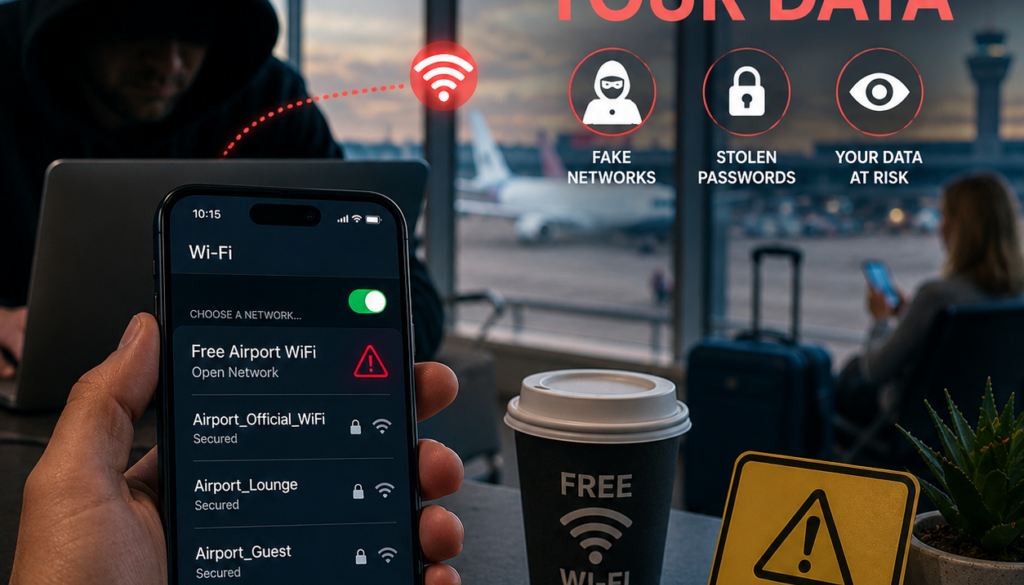
Attackers often create fake WiFi networks designed to look legitimate, tricking travellers into connecting without realising the danger.
Important:
The biggest danger ito Airport WiFi safety is often not the official airport WiFi — it’s fake networks pretending to be the official one.
The biggest danger ito Airport WiFi safety is often not the official airport WiFi — it’s fake networks pretending to be the official one.
Cybersecurity agencies like Europol and the US TSA have repeatedly warned travellers about fake hotspot scams and unsecured public networks.
Real-World Airport WiFi Attacks
In 2024, the Australian Federal Police charged a man accused of creating fake airport and airline WiFi networks at several Australian airports including Melbourne, Perth, and Adelaide.
According to reports, investigators allegedly discovered dozens of stolen login credentials linked to the scam.
These types of attacks are commonly referred to as:
- WiFi honeypots
- Evil twin networks
- Fake captive portals
Many travellers connect without noticing small spelling differences in the network name.
Airport Wifi Safety and The Most Common Airport WiFi Scams
1. Evil Twin Networks
An attacker creates a fake WiFi network using a name that appears official.
Examples include:
- Free Airport WiFi
- Airport_Guest
- Qantas Lounge WiFi
- Airport Free Internet
Travellers connect believing the network is legitimate.
2. Man-in-the-Middle (MITM) Attacks
In a man-in-the-middle attack, a hacker positions themselves between your device and the internet connection.
This may allow them to:
- Capture passwords
- Steal browsing sessions
- Monitor activity
- Access sensitive information
3. Fake Login Portals
Some fake airport WiFi systems redirect travellers to login pages that appear genuine.
Users may unknowingly enter:
- Email addresses
- Passwords
- Social media logins
- Personal details
Why eSIM Mobile Data Is Safer
Using a travel eSIM is generally much safer than relying on public WiFi hotspots.
Instead of sharing an open network with hundreds of strangers, your device connects directly through a secure mobile network.
This significantly reduces the risk of:
- Fake hotspots
- Interception attacks
- Public network monitoring
- Suspicious login portals
Roamzy Travel Tip:
Installing your eSIM before your flight means you can land connected instantly without needing airport WiFi at all.
Installing your eSIM before your flight means you can land connected instantly without needing airport WiFi at all.
Benefits of Using a Travel eSIM
- Safer than public WiFi hotspots
- Instant mobile data on arrival
- No searching for airport WiFi passwords
- Better privacy while travelling
- More secure banking and app usage
- Avoid expensive roaming fees
Many travellers now combine eSIM connectivity with Roamzy Secure for additional online privacy protection while travelling internationally.
How Smart Travellers Stay Secure
Experienced travellers increasingly rely on secure mobile data instead of airport WiFi networks.
A smart travel security setup often includes:
- A travel eSIM
- VPN protection
- Two-factor authentication
- Avoiding unknown public hotspots
- Installing eSIMs before departure
Should You Ever Use Airport WiFi?
Official airport WiFi is not automatically dangerous to Airport Wifi Safety, but travellers should still be cautious.
If you must use airport WiFi:
- Confirm the official network name with airport staff
- Avoid entering sensitive passwords
- Use a VPN if possible
- Disable automatic WiFi connections
- Never use suspicious login portals
Helpful Roamzy Travel Guides
- Travel eSIM Setup Guide
- First Time Using an eSIM?
- Europe eSIM Plans
- Where’s Roamzy
- International Air Transport Association (IATA)
Frequently Asked Questions
Is airport WiFi safe to use?
Official airport WiFi can be reasonably safe, but fake hotspot scams remain a significant risk in busy international airports.
Are eSIMs safer than public WiFi?
Generally yes. Mobile data connections are typically more secure than open shared WiFi networks.
What is an evil twin WiFi network?
An evil twin network is a fake WiFi hotspot designed to look like a legitimate public network.
Should I install my travel eSIM before flying?
Yes. Installing before departure means you can land connected instantly without relying on airport WiFi.
Final Thoughts
Free airport WiFi may seem harmless, but it has become a common target for cybercriminals around the world.
For modern travellers, using a secure travel eSIM is one of the easiest ways to improve privacy, reduce security risks, and stay connected from the moment you land.
With Roamzy, you can avoid the stress of public hotspots and travel with confidence knowing your connection is safer, faster, and ready when you are.
🌍 Have you ever connected to suspicious airport WiFi while travelling?
Travel Smarter with Roamzy
Stay connected securely with Roamzy travel eSIMs and avoid risky public airport WiFi while travelling overseas.
Shop Roamzy eSIMs