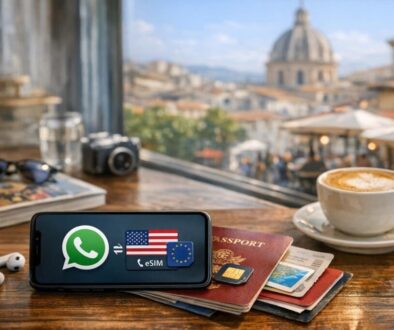

If I Have an Optus Plan, Do I Need an eSIM for Europe?
If you have an Optus plan and you’re heading to Europe, the short answer is: maybe not, but for many travellers an eSIM is the simpler and more predictable choice. Your Optus plan may work overseas with roaming options, but that does not always mean it’s the best value for a holiday, cruise, work trip, or multi-country trip.
Quick takeaway: if you want to keep your Optus number active for calls or texts, roaming can help. If you mainly need affordable mobile data for maps, messages, bookings, and social apps, a Roamzy Europe eSIM is often the more practical option.
For travellers who want to avoid bill shock and set everything up before departure, Roamzy’s Europe eSIM is a strong fit because it gives you a dedicated travel data option without relying on your home plan’s roaming rules.
Can You Use an Optus Plan in Europe?
In many cases, yes, but it depends on your Optus plan and the current international roaming terms attached to it. Some Australian plans offer overseas roaming options, while others require an add-on or separate activation. Coverage, countries included, data allowances, and pricing can change, so it’s important to check your current Optus account before you leave.
That means the real question is not just can you use Optus in Europe, but should you rely on it for the whole trip.
What roaming may allow
- Keeping your Australian number active overseas
- Receiving bank verification codes and important SMS
- Using mobile data without changing SIMs
- Making and receiving calls, depending on your plan
What to check in your Optus plan before you leave
- Whether Europe is included in your roaming destination list
- If roaming is already active or needs to be switched on
- Whether charges apply per day, per MB, or through an add-on
- Whether calls, SMS, and data are all included
- Any fair use rules or speed limitations
If you are unsure, check the latest Optus international roaming terms on the official Optus website before you travel.
What’s the Difference Between Optus Roaming and a Europe eSIM?
This is where most travellers make the decision. Optus roaming and a Europe eSIM can both keep you connected, but they work very differently.
| Feature | Optus roaming | Europe eSIM |
|---|---|---|
| Best for | Keeping your Australian number active | Affordable travel data |
| Setup | Usually through your carrier account/settings | Buy and install before or during travel |
| Data control | Can be harder to predict if charges vary | Usually easier to plan around a fixed package |
| Calls and SMS | Often included depending on roaming terms | Data only unless a calling feature is included |
| Number retention | Yes, your Optus number stays active | Yes, if used as a second data line on a compatible phone |
| Multi-country travel | Depends on roaming coverage and terms | Often better suited to Europe trips across several countries |
How roaming works
Roaming uses your Australian mobile service while you’re overseas. Your phone connects to a partner network in the country you’re visiting. That’s convenient, but it can also be expensive if you use your phone the same way you do at home.
This matters most for:
- Google Maps and navigation
- Uploading photos and videos
- Using hotspots
- Watching reels, streaming, or video calls
How an eSIM works
An eSIM is a digital travel SIM that you install on a compatible phone. Instead of swapping physical SIM cards, you add a travel data plan directly to your device. That makes it especially useful when you want data ready as soon as you land.
For Europe, that can be a big advantage if you’re arriving late, connecting through multiple airports, or moving between countries by train.
Key differences in cost, setup, and flexibility
In practice, the biggest difference is predictability. Roaming can be simple if your plan covers what you need at a price you’re comfortable with. But many travellers prefer an eSIM because they can choose a plan that suits their trip length and expected data use.
If you only need data for a few basic tasks, a Europe eSIM can be much easier to budget for than using your Optus plan abroad.
Do You Actually Need an eSIM if You Already Have Optus?
Not everyone needs an eSIM. Some travellers are fine with roaming. Others find it stressful, expensive, or too easy to forget how much data they’re using.
The right choice depends on how you travel.
When Optus roaming may be enough
- You only need your phone for light use
- You mainly want to receive SMS and verification codes
- You’re travelling for a short time
- Your Optus roaming terms are straightforward and affordable for your trip
- You don’t want to manage a second mobile plan
When an eSIM is the better choice
- You want predictable travel data costs
- You’ll use Google Maps, ride-share apps, and messaging every day
- You’re visiting multiple European countries
- You prefer to set everything up before you leave Australia
- You don’t want to risk roaming charges building up in the background
Who benefits most from each option
| Traveller type | Better option | Why |
|---|---|---|
| Short-stay holidaymaker | Either | Depends on roaming terms and how much data you use |
| Multi-country traveller | eSIM | More flexible across borders |
| Business traveller | eSIM + Optus number | Keep your number while using travel data |
| Retiree | Depends | Choose the simplest option based on support needs and usage |
| Family trip | eSIM | Often easier to manage data on the go |
| Heavy data user | Unlimited plan or a larger eSIM package | Video, maps, and hotspot use add up quickly |
What to Consider Before Deciding
Before you decide whether to rely on Optus or switch to an eSIM, think about how you’ll actually use your phone in Europe.
Data usage
If you mostly use WhatsApp, maps, email, and the occasional web search, an eSIM can be enough for the trip. If you plan to upload videos, make hotspot connections, or stream on trains and in hotels, roaming may become costly fast.
Trip length
For a weekend or a short business trip, roaming may be acceptable if the terms are reasonable. For a longer Europe itinerary, an eSIM often gives better control over costs.
Number of countries visited
Europe trips often involve crossing borders. That makes a regional Europe eSIM attractive because you don’t need to keep checking whether your mobile service changes from one country to the next.
Need for a local or backup connection
Many travellers like to keep their Australian number active for calls, SMS, and bank codes, while using an eSIM for travel data. That gives you the best of both worlds if your phone supports dual SIM.
Can You Use Optus and an eSIM at the Same Time?
On many modern phones, yes. If your device supports dual SIM or eSIM, you can usually keep your Optus line active while using a Europe eSIM for data. That’s a popular setup because it lets you:
- Keep receiving SMS on your Optus number
- Use the eSIM for mobile data
- Reduce the risk of roaming charges on your main line
- Switch settings quickly if needed
This is especially handy when you need one number for verification codes and another connection for everyday data use.
How to Set Up an eSIM for Europe
Setting up a Europe eSIM is usually straightforward, but it’s best to do the prep work before you’re standing in an airport queue.
1. Check device compatibility
First, make sure your phone supports eSIM. Most newer iPhones and many recent Android models do, but it’s worth checking before you buy anything.
2. Buy and install before departure
Installing your eSIM at home means you can test it in advance and avoid relying on airport Wi-Fi. Once installed, it should be easy to switch on when you land.
3. Set your phone correctly
Usually, you’ll want to:
- Keep your Optus line on for calls or SMS if needed
- Set the eSIM as your data line
- Turn off data roaming on your Optus line if you don’t want roaming charges
If you’re not confident with the setup, do it before you leave so you can test it on home Wi-Fi.
Best Option for Most Travellers
For most Australians travelling through Europe, the better answer to if I have an Optus plan, do I need an eSIM for Europe is: yes, probably for data, especially if you want a predictable, travel-friendly setup.
Optus roaming may still be useful if you need to keep your number active. But for everyday travel data, an eSIM is usually easier to understand, easier to budget, and less stressful to use across multiple countries.
Simple rule of thumb:
- Use Optus roaming if you mainly care about keeping your number active and your usage is light.
- Use a Europe eSIM if you want cheaper, clearer, and more flexible travel data.
Roamzy’s Europe eSIM Options
If you’d rather travel with a separate data connection, Roamzy’s Europe eSIM is designed for travellers who want to stay online without depending on roaming rules from home.
It’s a practical choice for:
- Airport arrivals
- Navigation and ride apps
- Train and city travel across Europe
- Families managing multiple devices
- Business trips where dependable data matters
If your trip is heavy on data, you may also want to look at Roamzy’s Unlimited Data Plans. If you’ll be moving through more than one region, a regional eSIM may suit you better.
And if you plan to rely on airport or hotel Wi-Fi at times, Roamzy Secure™ can add a helpful layer of privacy when you’re browsing on public networks.
Roamzy Travel Tip™
💡 Roamzy Travel Tip™: If you’re using both Optus and an eSIM, test the setup before you leave Australia. Make sure your phone is using the eSIM for data and that your Optus line is only doing what you actually want it to do. That one check can save a lot of confusion after landing.
Useful Before You Go
- What is an eSIM?
- How does an eSIM work?
- How to check if your phone supports eSIM
- How to install an eSIM before you travel
- Roaming vs eSIM
- Best way to stay connected while travelling in Europe
- How to avoid roaming charges overseas
- International travel data tips
Authoritative Sources to Check Before Travelling
- Optus official website
- Optus international roaming information
- Australian Communications and Media Authority
Frequently Asked Questions
Can I use my Optus plan in Europe?
Often yes, but it depends on your current plan and Optus roaming terms. Always check the latest roaming settings and costs before you travel.
Is an eSIM cheaper than Optus roaming?
In many cases, yes for mobile data. An eSIM usually gives you a clearer upfront cost, while roaming may be harder to predict if you use your phone a lot.
Can I keep my Optus number and still use an eSIM?
Yes, on many dual SIM-compatible phones you can keep your Optus line active and use the eSIM for data.
Do I need a dual SIM phone for a Europe eSIM?
Not always, but dual SIM support is very useful if you want to keep your Optus number while using travel data on an eSIM.
Should I use Optus for calls and an eSIM for data?
That can be a good setup if your phone supports it and you want to keep your number available for calls or verification codes while avoiding roaming data charges.
Will an eSIM work across multiple European countries?
Many Europe eSIMs are designed for multi-country travel. Check the plan details before buying so you know exactly where it works.
Should I turn roaming off on my Optus line if I buy an eSIM?
If you don’t want to use roaming data, it’s usually smart to turn data roaming off on your Optus line and use the eSIM for mobile data instead.
What’s the easiest option for first-time travellers to Europe?
For most first-time travellers, a Europe eSIM is the simplest way to get travel data without worrying about roaming surprises.
Final Verdict
If you have an Optus plan and you’re travelling to Europe, you may not need an eSIM, but many travellers will be better off with one. Optus roaming can be useful for keeping your Australian number active, yet a Europe eSIM usually gives you more control, better predictability, and less stress once you land.
If you want the easiest way to stay connected for maps, messages, bookings, and everyday travel data, Roamzy’s Europe eSIM is a sensible place to start.
For travellers who want to keep things simple, that usually answers the question: if I have an Optus plan, do I need an eSIM for Europe? The safest answer is that an eSIM is often the better travel tool, even if you keep Optus active for your number.